

Know Your Rights: Interacting with ICE
Introduction
As Governor of Delaware, I want every Delawarean to understand their rights. In our state, we believe in dignity, fairness, and the rule of law. Every person has certain constitutional protections, regardless of immigration status. Please watch these videos and see below for more resources from the Delaware Department of Justice en español & an kreyòl.
The information below is provided to help you better understand your rights and resources if you interact with the U.S. Immigration and Customs Enforcement (ICE). It is intended for informational purposes only and does not constitute legal advice.
Know Your Rights
- Remain calm. Do not run. Do not physically resist or interfere.
- You have the right to ask whether you are being detained, or if you are free to leave.
- You have the right to remain silent. You do not have to answer questions about your immigration status, where you were born or how you entered the country.
- If you choose to speak, do not provide false information or false documents.
- If you choose to speak, do not provide false information or false documents.
- You have the right to consult with an attorney before answering questions or signing any documents.
- You have the right to ask for an interpreter if you need one.
- You generally have the right to refuse a search of your person or belongings.
- A protective pat-down for safety is different. Officers may conduct a limited pat-down over your clothing if they believe it is necessary for safety.
- A protective pat-down for safety is different. Officers may conduct a limited pat-down over your clothing if they believe it is necessary for safety.
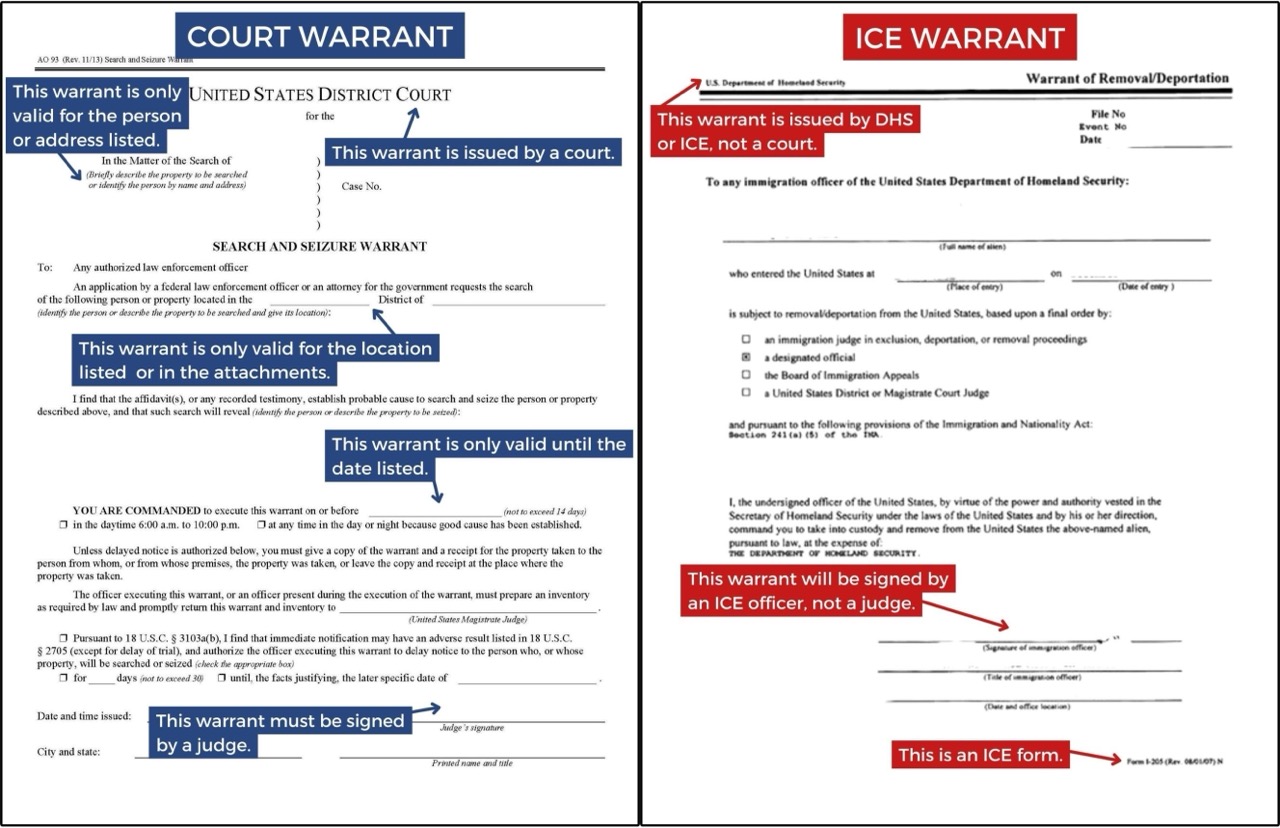
- In most cases, ICE cannot enter your home without your consent unless they have a judicial warrant signed by a judge.
- You can say no to ICE entering your home.
- You can say no to ICE entering your home.
- An administrative warrant issued by ICE or the Department of Homeland Security is not the same as a court-issued warrant signed by a judge.
- You have the right to ask to see the warrant, including through a window, before opening your door.
- You do not have to consent to entry or a search. You can say no.
- If you see ICE agents in your community, you have the right under the First Amendment to record or take photos in public view of law enforcement and ICE from a safe distance.
If you believe your rights were violated, document what happened as soon as you can and consider speaking with a lawyer.
Be Prepared
- Carry valid, state-issued identification if you have it. Do not carry false documentation.
- Keep copies of important immigration paperwork in a safe place. Let a trusted family member or friend know where those are.
- Memorize an emergency contact number.
- If you have children, create a care plan in case you are unable to pick them up. Share that plan with a trusted adult.
- Make sure your child’s authorized pick-up list at school is current.
- If your children are with you when you are stopped, you may request to make a phone call so a caregiver can come. If they are not with you, you may request to make a phone call to ensure they are safe.